
You need pavements and yard surfaces that keep working under heavy loads.
When soils are weak, pavements crack, settle, or rut fast.
Soil stabilization gives ground the strength it needs for roadways, truck yards, loading docks, and utility trenches.
Our team explains common stabilization methods, how they fit into excavation and utility work, and how Eagle Rock Excavating applies these methods for sites in Arizona and nearby regions.
Why Soil Stabilization Matters for Heavy Traffic Areas
 Soil under a paved or hard surface carries every wheel, axle, and load above it.
If the subgrade is loose, compressible, or high in clay, it will deform under repeated loads and let the pavement fail.
That is especially true in areas with heavy trucks and forklifts.
Improving the strength and stiffness of the subgrade reduces settlement and surface cracking and lowers maintenance costs over time.
Research shows that stabilizing soils can reduce deformation and extend pavement life.
A Federal Highway Administration review notes that chemical stabilization with lime, cement, or fly ash changes weak soils so they carry heavier loads and stay stable under wet and dry cycles.
The FHWA paper explains where these methods are appropriate and how they affect drainage and durability.
Common Soil Stabilization Methods Explained
Mechanical Stabilization
Mechanical methods change the soil structure with compaction and granular fills.
Contractors remove unsuitable material or blend it with crushed stone or aggregate to create a stronger base.
Mechanical stabilization is often the first step before any chemical treatment.
In practice, mechanical stabilization means placing backfill in lifts, moisture conditioning each lift, and compacting with rollers or vibratory equipment.
Compaction increases density and reduces voids so loads are spread more evenly.
Studies show that small increases in in-place density can greatly improve pavement performance.
One summary from the National Center for Asphalt Technology reports that reducing air voids by 1 percent can significantly improve fatigue resistance and rutting performance.
Chemical Stabilization
Chemical stabilization changes the soil’s properties through additives. Lime and cement are common stabilizers.
When mixed into clayey or organic soils, lime flocculates fine particles and promotes reactions that harden the soil.
Cement creates cementitious bonds that increase strength and stiffness.
These methods cut how much new material you must bring in.
That reduces truck trips and material hauling which supports more sustainable building methods.
The FHWA technical summary on soil and base stabilization reviews these treatments and their appropriate uses.
Geosynthetics and Reinforcement
Geotextile fabrics, geogrids, and other geosynthetics separate weak soils from fill, distribute loads, and control erosion.
When placed between a soft subgrade and an aggregate base, geosynthetics reduce rut depth and extend service life. In places with collapsible soils or wet-dry cycles, this approach is a cost-effective way to add strength without deep excavation.
Surface Treatments and Soil Cement
Soil cement, a mix of soil, cement, and water compacted and cured, provides a tough base layer that resists moisture and traffic loads.
It can be a good match for parking areas and industrial pads where heavy loads are frequent.
How Stabilization Fits into the Excavation and Utility Process
 Preconstruction Site Assessment
Before any soil work starts, a site review and basic soil testing should be done.
That helps pick the right method.
Eagle Rock Excavating runs field checks and coordinates with geotechnical reports when available.
Matching methods to soil conditions keeps projects on schedule and reduces surprises.
Integrating Stabilization with Utility Excavation
Utility trenches and underground work change the load path under a pavement.
When utility excavation cuts through a base, the trench backfill needs extra attention.
Using stabilization methods next to or within trenches prevents weak spots that cause localized failures.
If chemical stabilization is planned near trenches, contractors must use safe digging practices so underground utilities are protected.
OSHA trenching rules and the Call 811 process are critical here.
OSHA has clear standards for excavation safety including protection from cave-ins and requirements for means of egress in trenches of certain depth.
Calling 811 before you dig reduces the chance of hitting utilities and is an industry standard practice.
Coordination and Sequencing
Successful stabilization and utility excavation require clear sequencing.
Typical steps look like this in the field:
- Mark and locate existing utilities using 811 and hand-digging in tolerance zones.
- Excavate to design depth with controlled cuts.
- Remove unsuitable soil where needed and place mechanical stabilization layers.
- Apply chemical stabilizers if required and mix to target depth and moisture.
- Compact each lift to the specified density and test in the field.
- Backfill trenches with selected material and compact around utilities with care.
- Finish grade and install pavement or surface.
This sequencing helps prevent weak points next to utility lines and keeps safe digging practices front of mind.
How Chemical Soil Stabilization Works
If you are new to this, think of chemical stabilization as a way to make weak soil act more like rock.
Lime and cement change the chemistry and binding of fine particles.
After mixing and curing, the soil becomes firmer and less likely to swell or shrink when it gets wet or dry.
Lime works well on clay soils.
It changes the electrical charge of particles so they group into clumps that compact better. Cement creates cement-like bonds that add stiffness.
Those changes help the soil carry heavier loads and handle wet conditions without softening.
Safety Steps Every Project Must Follow
Working near utilities is high risk.
Hitting a gas line, electric cable, or water main can cause injury and costly delays.
Two nonnegotiable steps reduce that risk.
1. The First Step
You must first call 811 or use your state 811 center before you dig.
The national Call 811 program gives you a 99 percent chance of avoiding utility strikes when used.
Marking utility locations is the primary step in planning safe digging.
2. The Second Step:
Follow OSHA trenching and excavation rules.
Those rules require protection for workers in trenches and specify safe entry and exit points for excavations deeper than four feet.
OSHA guidance also stresses testing for atmospheric hazards and protection from vehicular traffic near the trench.
These practices protect workers and public infrastructure.
Choosing Between Methods for Arizona Conditions
Parts of Arizona have clayey, reactive soils such as the Phoenix series which can expand and shrink with moisture.
The USDA soil series record for Phoenix describes these soils as fine textured and prone to moisture-related volume change.
That makes stabilization attractive in many locations where heavy loads are expected.
When deciding on a method, consider these simple points:
- If the soil is very soft or organic, excavation and import of better fill may be necessary.
- If soils are clayey but not highly organic, lime may improve workability and strength.
- If you want minimal import and a stiffer base, soil cement or cement stabilization can be effective.
- If budget or schedule limits deep work, geosynthetics combined with mechanical stabilization may be the best balance.
How Eagle Rock Excavating Uses Stabilization Methods in the Field
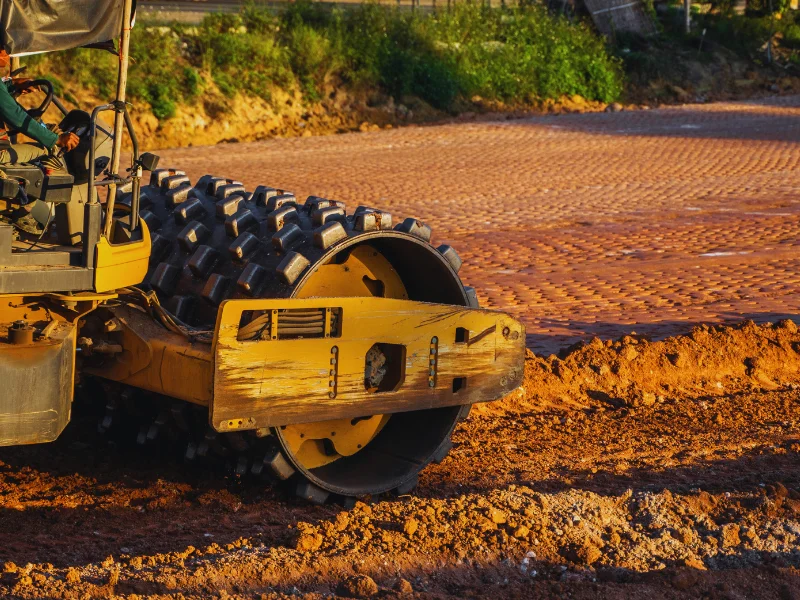 Our crew applies mechanical and chemical stabilization methods as part of their precision excavation services and utility excavation work.
The company coordinates safe dig services and follows safe digging practices when excavation underground utilities is involved.
We mix stabilization into trench backfill or large pad areas when soil testing and project needs call for it.
The result is fewer weak spots next to utilities and stronger pavement sections across the site.
When our team stabilizes soils, the field steps include locating utilities, making controlled excavations, placing additives or geosynthetics, mixing or spreading materials, compacting each lift, and testing density.
That step sequence keeps work safe and helps finished surfaces carry heavy traffic loads.
Frequently Asked Questions
What Is the Difference Between Mechanical and Chemical Stabilization?
Mechanical stabilization improves soil by adding and compacting granular materials such as crushed stone.
Chemical stabilization changes the soil chemistry and binds particles with lime or cement.
Both increase strength but work in different ways and suit different soils.
Can Stabilization Harm Nearby Utilities?
If done without safe digging practices, any excavation or mixing can threaten utilities.
That is why safe dig services and following 811 and OSHA guidance are essential before mixing or heavy equipment enters a site.
Proper utility marking and hand excavation in tolerance zones prevent accidental contacts.
How Long Before I Can Pave Over Stabilized Soil?
Timing depends on the method.
Soil cement or cement mixes often need curing time to develop strength.
Lime treatments also need a reaction period.
Scheduling is part of the project plan and Eagle Rock coordinates curing time when stabilization is required.
Talk With Our Team About Smarter Ground Preparation
Stabilization of soil gives ground the strength needed to support heavy traffic and complex utility layouts.
If you want reliable soil strength under paved areas or safer utility excavation, Eagle Rock Excavating can coordinate stabilization with utility excavation and precision excavation services so sites perform well under heavy use.
Call or request a quote from our team to discuss stabilization options and how they fit your next project in Arizona.
Stabilized soil helps reduce repairs and keeps your operations moving.


