
 Arizona’s monsoon season brings the most intense rainfall of the year, with flash storms delivering more than half of annual precipitation in under an hour.
Many of these rainfalls happen in urban neighborhoods where drainage is often overlooked.
The real concern isn’t just wet lawns; it’s what’s happening under the surface.
FEMA reports that just one inch of floodwater can cause up to $25,000 in property damage.
That’s why drainage planning is especially important in Arizona.
Eagle Rock Excavating handles drainage and excavation for larger residential developments.
But the same core methods can still help if your home sits in a growing subdivision or planned community.
Swale vs French Drain: Key Differences Explained
What Is a Swale?
A swale is a shallow, grassy channel that’s graded to guide water away from your home or across your yard.
It looks like a dip or depression in the landscape, but its purpose is to carry water slowly to a designated drainage area.
Swales work well in large or sloped yards where surface runoff can travel naturally.
The water is directed, filtered through vegetation, and absorbed gradually into the soil.
Swales are typically more visible and require space.
They don’t need any piping or gravel layers, but the slope must be consistent.
The EPA recommends a slope of at least 2% to help move water, and the soil should be shaped to reduce pooling.
What Is a French Drain?
A French drain is a gravel-filled trench that uses a perforated pipe to collect and redirect groundwater or surface water.
It’s usually hidden underground and covered with soil or turf.
French drains are ideal in tight areas where visible drainage features aren’t possible or desirable.
This option works especially well for flat lots and clay-heavy yards where surface water doesn’t move easily.
The trench captures water and directs it to a dry well, swale, or stormwater drain.
French drains are more discreet and can be installed closer to buildings or driveways, which is why they’re common in urban areas.
Choosing Between Swale vs French Drain in Arizona
 When a Swale Makes Sense
If you live on a larger lot with open space and natural slope, a swale may be the simpler choice.
In many Arizona communities, especially those with custom homes or semi-rural setups, swales are used to manage stormwater on-site.
They also support vegetation and help reduce runoff during heavy rains.
However, a swale requires regular upkeep.
Grass must be kept trimmed, sediment cleared out, and grading maintained.
If neglected, the swale can turn into a pond after a storm.
When a French Drain Works Better
French drains are often used in subdivisions where lot sizes are small and the distance between homes is tight.
Since they’re underground, they don’t interrupt the yard’s look.
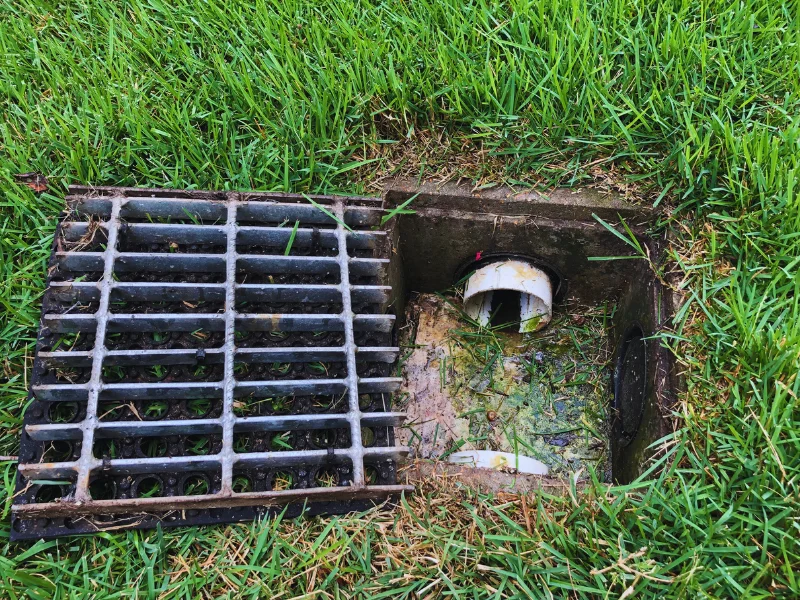
These systems are especially useful in residential storm water drainage systems where surface drainage isn’t possible due to fencing, concrete patios, or structures.
In clay-heavy areas like many neighborhoods in Tucson and Phoenix, French drains provide faster relief during heavy rains.
According to the Natural Resources Conservation Service, clay soil drains more slowly than sandy soil, which is a major reason French drains are a practical fix.
Using French Drains in Clay Soil: What You Should Know
Why Clay Soil Needs Special Drainage
Clay soil holds water for a long time.
During Arizona’s dry months, it may seem hard as a rock, but once it rains, that same soil turns into a water trap.
This is where French drains in clay soil can be useful.
When installed with proper gravel, filter fabric, and spacing, French drains can collect standing water and redirect it before it pools too long.
Installation Tips for Clay Soil Conditions
When installing a French drain in clay soil, it’s important to:
- Use coarse gravel (not pea gravel)
- Add a geotextile fabric to prevent clogging
- Maintain a proper slope (minimum 1%)
These adjustments help make the system last longer and perform more effectively.
How To Fix Yard Drainage Without Digging Everything Up
Evaluate First, Dig Second
Before adding any system, it helps to assess your yard after a strong rain.
Look for puddles that stay more than a day or two.
Are there low spots around the foundation? Is water running toward the house instead of away from it?
Many problems come from poor grading rather than a lack of drains.
The Building America Solution Center recommends sloping the ground away from the foundation at a rate of at least 0.5 inch per foot for 10 feet.
If your yard doesn’t meet that standard, regrading might be needed before installing a system.
Other Lawn Drainage Solutions to Try First
Sometimes small adjustments make a big difference.
Try these before going into a full excavation:
- Extend gutter downspouts farther from the house
- Add a dry creek bed to move water gently across the yard
- Use porous pavers in walkways or driveways
If these don’t work, that’s when it’s worth looking into French drains or swales.
How Residential Drainage Systems Connect to Larger Developments
 Many Arizona homes are part of larger housing tracts built with master drainage plans.
Eagle Rock Excavating works with developers to grade lots, install sitewide drainage systems, and maintain soil control during construction.
While our primary work is commercial, the excavation, layout, and stormwater planning we do sets the stage for how well individual homes drain later on.
If your neighborhood is seeing pooling, erosion, or failed drainage, it could be tied to wider issues in the development layout.
This is common in areas where lots were graded too flat or swales were not maintained after construction.
We’ve worked with general contractors and municipalities across Arizona to fix these problems before they affect homeowners further.
Choose Between Swale vs French Drain for Arizona Homes
If you’re trying to decide between a swale vs French drain, consider your yard’s size, slope, soil, and layout.
In Arizona’s climate, with its dry spells and sudden storms, drainage is serious.
Swales are simple and natural but need space.
French drains are compact and effective but more technical to install.
For clay soil and small urban yards, French drains often perform better. In open or sloped areas, a swale can move water across the yard more easily.
Both can work if they’re built with the right slope and materials.
Eagle Rock Excavating has worked on drainage projects for subdivisions, roadways, and commercial developments across Arizona.
If your property is part of a larger development, or if you’re seeing signs of poor water flow, it might be time to take a closer look.
Give us a call and see how proper grading, soil prep, and drainage systems can protect your home and the neighborhoods around it.


